Eugene/Springfield Real Estate and Community News

May 6, 2026

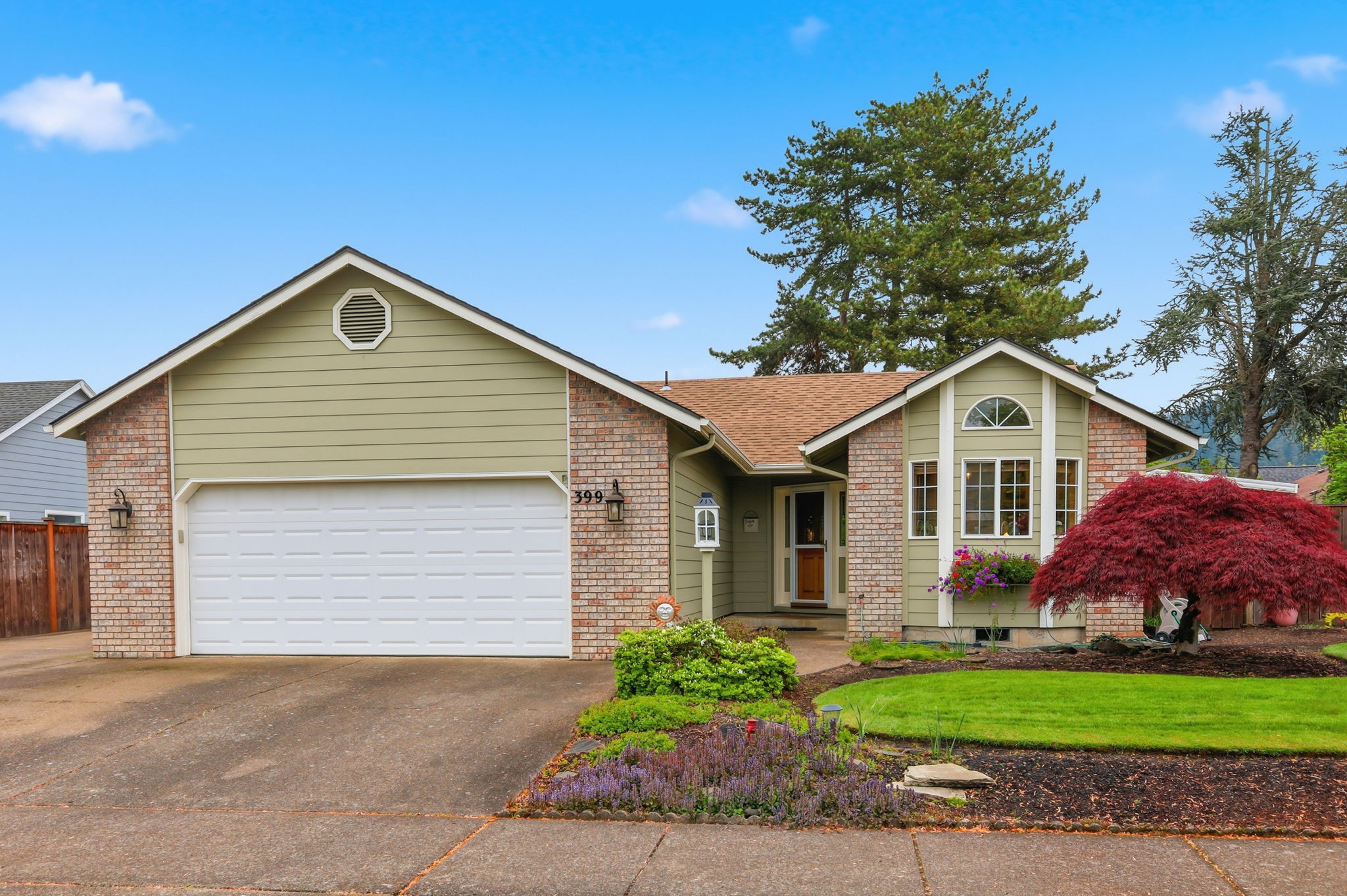
399 N 72nd Pl, Springfield, OR 97478

399 N 72nd Pl, Springfield, OR 97478

3 Bed I 2 Bath I 1,432 sqft

$475,000

View Listing Here!


Say hello to this bright, easygoing home with 3 bedrooms and 2 bathrooms—all on one level. The layout feels open and relaxed, and the big windows let in tons of natural light plus great views of the backyard.

The living room has a cozy wood-burning fireplace and opens right out to the patio.The backyard is set up for enjoying the outdoors, with two different spots to sit and relax.

The primary bedroom is nice and spacious, with an extra area that could be your home office, workout spot, or whatever you need.

You’ve also got space for an RV, new flooring, fresh exterior paint, a newer furnace, and a roof that was replaced in 2021—so a lot of the big stuff is already taken care of.

Overall, it’s a super inviting place with a great indoor-outdoor feel. Come check it out!


Haas Team Real Estate
541.349.2620
galand@galandhaas.com

Posted in Homes For Sale
May 4, 2026

Don’t Wait: Why Buyers and Sellers Should Act in Today’s Market

Welcome to the wild, wild world of mortgage interest rates. Just when we needed a bit of help with the national housing market, the Fed decided that war-driven inflation was more important to address than a stagnant housing market.

But even with little help from the Fed, it’s easy to see that the national housing market is ready to take off. Despite the Fed holding rates steady and mortgage rates ticking slightly upward, buyer activity remains strong.

In the Eugene and Springfield markets, there is no shortage of ready homebuyers right now. Our biggest challenge is the lack of available inventory. At a time of year when listings typically begin to increase, that just isn’t happening yet.

My prediction remains the same: don’t expect mortgage rates to change drastically in either direction in the foreseeable future. For homebuyers, it makes little sense to wait. For sellers, now is the time to take advantage of a strong pool of buyers who are struggling to find homes to purchase.

The following is an article from the National Association of Realtors blog.

Mortgage rates ticked back up this week, averaging 6.30%, Freddie Mac reports. Despite the increase, rates remain well below the 6.76% average from a year ago. And buyers are starting to show up in force: Mortgage applications to purchase a home—often viewed as a gauge of future homebuying activity—jumped 21% in the latest week compared to a year ago, according to the Mortgage Bankers Association.

“After a brief pause, in part because of the elevated geopolitical uncertainties, potential home buyers certainly appear to be moving forward this spring and taking advantage of the more favorable inventory conditions in most parts of the country,” MBA Chief Economist Mike Fratantoni says.

Freddie Mac Chief Economist Sam Khater concurs. “It is clear that purchase demand continues to hold up as prospective buyers react to both modestly lower rates and more inventory to choose from than [in] the last few years,” he says.

Accepting a New Norm?  

More consumers may be adjusting to a new normal in rates, showing greater willingness to move forward even if it means giving up their ultra-low mortgage rate from a few years ago. A newly released Coldwell Banker report found that real estate professionals say one in three sellers are showing willingness to give up their sub-5% mortgage rate this spring.

The so-called “lock-in effect” has played a major role in the housing market, with the report noting it has been “one of the biggest and most persistent constraints on housing supply” as homeowners refuse to sell.

Now, signs are showing that could finally be easing.

“On the seller side, many homeowners are listing because their circumstances require a change, even if it means giving up a historically low mortgage rate,” says Jason Waugh, president of Coldwell Banker Affiliates. “Working through the lock-in effect will take time. But we are starting to see early signs that it is loosening, particularly in the Midwest and in the West, which could have a meaningful impact on inventory.”

Slightly more than half of outstanding mortgages have a rate that is 4% or lower, while 78% of borrowers have a rate below 6%, according to an analysis from Realtor.com®.

Mortgage Rates This Week

The Federal Reserve voted Wednesday to hold its benchmark short-term rate unchanged at its April meeting. While the Fed doesn’t directly set mortgage rates, its decisions can influence them. Mortgage rates, however, are more closely tied to long-term Treasury yields, which economists said moved higher this week amid rising oil prices tied to ongoing geopolitical tensions. That pushed the bond yield—and then mortgage rates—up as well.


Have An Awesome Week!

Haas Team Real Estate

541.349.2620

galand@galandhaas.com

April 27, 2026

Take Advantage of Today’s Mortgage Rates While You Can

After a brief period of sub-6% mortgage interest rates, we’ve seen rates fluctuate significantly. This past week was no exception, though we did see some decline in mortgage rates, which was a welcome change.

What we all need to understand, however, is that it may be many years—if ever—before we see mortgage rates return to 3% again. The new norm may be close to what we’re experiencing right now, or possibly even higher.

Our national debt, which forces the government to print money, along with other factors, is contributing to inflation. Inflation leads to higher interest rates, and we may need to accept that today’s mortgage rates are actually quite good.

So, if you find yourself waiting for 3% rates—or anything close—you may have a long wait ahead. In fact, my advice is that if you’re serious about purchasing a home, you should take advantage of the rates available now. There’s no guarantee we’ll see anything significantly better in the near future.

Here is an article published this week by the National Association of Realtors.

Home buyers may want to take note: Mortgage rates are falling again, hitting the lowest level during a spring buying season in years and offering a potential fresh boost to affordability.

The 30-year fixed-rate mortgage fell to a 6.23% average this week, Freddie Mac reports.

“Rates currently stand at their lowest level in the last three spring homebuying seasons,” says Sam Khater, Freddie Mac’s chief economist. “This improvement, coupled with a pickup in purchase applications and refinance activity, as well as an increase in monthly pending home sales, underscores signs of improving momentum in the market.”

The National Association of REALTORS® reported earlier this week that pending home sales—a forward-looking indicator based on contract signings—rose 1.5% in March compared to February. Still, housing inventory remains constrained. Lawrence Yun, NAR’s chief economist, pointed to pent-up housing demand, noting that “a greater supply of inventory will help translate that demand into more home sales.”

Meanwhile, home buyers do appear to respond whenever rates drop. Mortgage applications for home purchases jumped 10% last week on lower rates and are up 14% compared to a year ago, the Mortgage Bankers Association reported Wednesday.

“Despite the geopolitical uncertainty, housing demand is being supported by a still resilient job market, and home buyers are experiencing a buyer’s market in most of the country,” Mike Fratantoni, chief economist at MBA, said in a statement.

Mortgage Rates This Week  

Here’s a closer look at the national average in mortgage rates for the week ending April 23:

  • 30-year fixed-rate mortgages: averaged 6.23%, down from last week’s 6.30% average. A year ago, 30-year rates averaged 6.81%.

  • 15-year fixed-rate mortgages: averaged 5.58%, down from last week’s 5.65% average. A year ago, 15-year rates averaged 5.94%.  


Have An Awesome Week!

Haas Team Real Estate

541.349.2620

galand@galandhaas.com

April 21, 2026

The State of the Housing Market: Insights from realtor.com

The following article, recently published on Realtor.com, does an excellent job of describing the current national housing market, how we got here, and where we’re headed. It is a bit lengthy, but well worth the time to read.

Picture it: Gas is $2.69 per gallon, eggs are $1.50 a dozen, and rent is just $1,300 per month.

It’s 2019 in America, and the country has yet to go through the years of high inflation that will drive the price of gas up to $4.10, eggs to $6.22, and rent to $1,700—along with the cost of many other essentials.

While it’s no secret that affordability has plummeted since the pandemic, a new analysis from the Common Sense Institute (CSI) reveals that some states were hit harder than others.

Today, the average U.S. household has about $2,170 in monthly discretionary income after covering taxes and essentials like food, gas, and shelter. But for those in the least affordable states, the surplus shrinks to just $800.

Housing remains the ultimate budget-breaker, and the greatest driver of state-by-state differences in affordability. The average household devoted 18.5% of its income to shelter and utilities in 2025. But that baseline shifts dramatically depending on the map: dropping to 13.5% in the most affordable state and spiking to a staggering 28.8% in the least affordable one.

It’s a dramatic display of how the housing crisis has spilled over into a larger affordability crisis. Overall, the report finds that households need to spend $15,400 more per year—or $1,280 per month—just to maintain the same standard of living they enjoyed in 2019.

The data reveals a consistent upward march across all categories. During the period examined, gas rose 16.5%, health insurance increased 22.8%, grocery costs climbed 25.1%, while the combined expense of shelter and utilities surged 33.9%.

Child care rose a whopping 39%, but the most aggressive percentage increase occurred in car insurance, which ballooned 41.2% over the same period.

Yet, percentage points don't tell the whole story. 

While other costs technically climbed faster, shelter remains the heavy anchor of the American budget. And because it commands the largest portion of household spending, families are uniquely vulnerable to even moderate swings in housing costs. 

“Shelter is the largest household expense captured in this analysis and is the overwhelming driver of the affordability crisis according to our rankings,” writes Zachary Milnesenior economist and research analyst at CSI and the report’s author. “Shelter costs have shaped the affordability landscape drastically over the last several years as the primary fiscal constraint facing U.S. households.”

On average, annual shelter and utilities expenses alone increased $4,934 from 2019 to 2025—a massive fixed and essential cost that ripples through every other financial decision.

Where affordability took the biggest hits

The decline in affordability was widespread, with 29 states and the District of Columbia seeing a net loss in household purchasing power. On average, residents in these states effectively lost 3.2% of their income to the rising tide of prices.

However, the deterioration was most severe in a handful of coastal and Northeast hubs. Rhode Island saw the sharpest decline, where households are spending a staggering 8.4% more of their income on higher costs. Massachusetts followed closely at 8.1%, with California ranking third at 7.1%.

These names will be familiar to anyone tracking the housing crisis. All three earned “F” grades on the State-by-State Affordability Report Cards from Realtor.com®—driven by high housing prices and sluggish new construction.

“For the states still struggling with affordability, it's not a case of which is the culprit between supply, demand, or ancillary costs; it's usually all three,” says Jake Krimmelsenior economist at Realtor.com. 

Rhode Island—which ranked last in the overall report card—accounts for 0.3% of the U.S. population, but filed only 0.1% of permits in 2024, despite new construction homes demanding a 43.8% premium. But, Krimmel notes, housing is rarely a solitary burden.

“One other thing that stood out was how correlated housing costs and child care tend to be,” he says. “States that ranked low on housing affordability often also did on child care affordability, representing a double whammy for families.”

Again, the geographic split here is striking. 

In Kansas—the nation's most affordable state for the service—a typical household spends 11.1% of its income, or roughly $915 per month. Meanwhile, in New York, that monthly burden nearly triples to a staggering $2,446, according to the report.

Where affordability actually improved

Despite the national trend, 21 states managed to buck the crisis and see modest improvements in affordability. Importantly, prices didn’t actually drop in these regions; rather, local income growth outpaced the rising cost of living, leaving households with more breathing room at the end of the month.

Kansas led this group, with households spending 5% less of their total income on essentials compared with 2019. New Mexico followed closely at 4.7%, with Utah seeing a 4.1% improvement.

According to Krimmel, these success stories usually stem from two different sources: "When it comes to what states have done right, there's always an element of luck and an element of skill."

For Kansas and New Mexico, the advantage was largely luck in dodging the massive pandemic-era affordability rush that saw costs skyrocket in regions like the Sun Belt. Because demand stayed steady, their baseline costs didn't explode.

Utah, however, is the prime example of skill. Despite being an epicenter for pandemic migration, the state managed to keep its head above water through aggressive policy.

“Utah saw its local economy boom, which led to both rising house prices and incomes,” Krimmel explains. “But as part of that boom, Utah was also able to add to construction to offset even more house price increases.”

For a sense of the scale of this effort, Utah was responsible for 1.6% of the nation's new building permits in 2024, despite having just 1% of the U.S. population. And by building its way through the boom, the Beehive state proved that supply is the ultimate shield against an affordability crisis.

A country divided by the bottom line

As politicians at every echelon of government scramble to tackle the rising cost of living, the lessons from the CSI analysis are clear: If you want to fix America’s affordability woes, you must start with the housing crisis. 

Shelter is the gravity that defines a household’s financial orbit, and when it's out of balance, the rest of a budget follows.

But here again are some punishing numbers. The U.S. is currently facing a housing shortage estimated at 4.03 million to 10 million homes—a deficit so large it might as well be a black hole. Meanwhile, builder confidence is tanking as high interest rates and fears of an economic downswing take hold.

To build our way out may come down to the factors Krimmel mentioned earlier: plenty of skill to navigate the uncertainty ahead, and a healthy dose of luck.


Have An Awesome Week!

Haas Team Real Estate

541.349.2620

galand@galandhaas.com
April 21, 2026

No, the Housing Market Isn’t Crashing—Here’s Why

Good Monday Morning!

Lately, many people I speak with about the local and national housing markets ask me if the housing markets are crashing. That is a really good question, as most people are not dealing with the housing market daily or following its national trends. One would need to do so to properly assess a complex housing market like the one we have today.

The answer is that neither our local housing market nor the national market is crashing. Recently, we have been in a market that was improving quickly as a result of high demand and lower mortgage rates. Along with this, we had an economy that was heading in a very positive direction.

Currently, we are experiencing a slight market dip due to factors that have negatively affected the housing market. All of these changes so far are simply normal market ups and downs. A true housing market crash would involve far more severe downward trends than what we are seeing right now.

At this time, nobody knows the true short- or long-term direction of the housing market, but it would take conditions that are much more severe and long-lasting to create a crash.

The following is an excerpt from Inman News that provides helpful insight into our current housing market and what a housing market crash actually looks like.

________

Carruth argues that comparisons to the 2008 housing crash overlook a fundamental shift in how mortgages are underwritten today. “Dodd-Frank changed everything,” he said. “Lending standards are much tighter. The average credit score of homeowners today is significantly higher than it was back then. Buyers today are overqualified in many cases.”

That tightening, combined with historically high levels of homeowner equity, creates a buffer against the kind of widespread distress that defined the last crash.

“I can’t think of a scenario where we see a major home price crash,” Carruth said. “Back in 2008, homeowners had no equity. Today, they have a lot of it.”

Even in the event of a broader economic downturn, Carruth expects the impact on housing to be limited. “If we go into a recession, it doesn’t necessarily mean housing collapses,” he said. “It likely just pulls back inventory.”

A transaction slowdown, not a price collapse

While Carruth dismisses the idea of a price crash, he acknowledges that the market is under pressure in other ways. “There’s no price crash, but we are in a transaction crash,” he said, pointing to affordability constraints, elevated mortgage rates and broader economic uncertainty.

He said that concerns about artificial intelligence’s impact on employment and geopolitical instability — including the war in Iran — have all contributed to buyer hesitation in recent months. 

Those pressures have slowed activity, but Carruth argues that, historically, home prices have adjusted just enough to sustain a baseline level of sales. “In a housing recession, the U.S. has never fallen below about 4 million existing home sales annually,” he said. “Prices will adjust to whatever they need to hit that number.”

That doesn’t necessarily mean sharp declines. “It could mean flattening. Some markets are down. But that’s a correction, not a crash,” he added. “There’s a big difference.”

‘Demand is getting bottled up’

For a true housing crash to occur, Carruth said several conditions would need to happen simultaneously, and none are present today. “You would need a flood of foreclosures, forced sellers and no buyers,” he said. “That’s just not the reality right now.”

Instead, the market is being shaped by constrained supply and delayed demand. “When demand pulls back, it doesn’t disappear; it builds,” he said. “It’s like turning off a faucet. When it turns back on, the pressure is even stronger.”

Demographics are also playing a role. Carruth pointed to a large cohort of Gen Z buyers entering their prime homebuying years as a key driver of long-term demand.

Experts estimate pent-up housing demand by comparing current millennial and Gen Z headship rates — the share of people who form their own households — with those of similarly aged cohorts from 2010 to 2014.

The gap between today’s rates and that earlier baseline points to a sizable shortfall. Roughly 1.82 million households that would likely exist under prior conditions never formed, held back by limited inventory and worsening affordability.

Put another way, there are nearly 2 million “missing” households among 18- to 44-year-olds compared to what demographic trends would normally produce.

“There are more thirty-somethings than ever who want to own homes,” he said. “That demand is getting bottled up.”

Rates, geopolitics and the road ahead

Recent volatility in mortgage rates has added another layer of uncertainty. Carruth said the housing market had begun to regain momentum earlier this year as rates dipped, but that progress was disrupted by geopolitical developments.

The war in Iran really put a wrench in things,” he said. “Rates were coming down, then they shot back up after the conflict escalated and the jobs report came in weak.”

Still, he sees those disruptions as temporary rather than structural. “I really hope this war in Iran ends soon, and if it does, we will be in very good shape,” Carruth said.

Looking further ahead, Carruth expects the housing market to expand over the next decade, even as the industry itself undergoes transformation. “The next 10 years will be historic,” he said. “We’ll likely see fewer agents because of technology and AI, but more transactions and higher prices.”


Have An Awesome Week!

Haas Team Real Estate

541.349.2620

galand@galandhaas.com
April 21, 2026

What’s Happening in the Eugene/Springfield Housing Market This Spring?

As the war in Iran continues and may even be escalating, the national housing market continues to slump. Our short-lived period that saw mortgage interest rates drop below 6% ushered in what appeared to be the beginning of much stronger demand for housing. Economic concerns stemming from the war have since created a climate of consumer uncertainty, along with mortgage interest rates that are now above 6%.

Rising fuel costs, changes in the bond market, and consumer reluctance have quickly reversed the short-term boom in housing that we all saw. Originally, there was hope for a quick in-and-out conflict, but that now appears unlikely. It is now becoming clear that hopes for a hot spring housing market may be fading.

If the war winds down within the next few weeks, there is still a chance that we could see an improved housing market by late spring. Even though the national housing market has declined, the numbers so far do not indicate anything close to a market crash. In the Eugene and Springfield area, we are seeing continued demand for homes, including multiple-offer situations in some price ranges.

Let’s all hope for an improving economy and a strong late spring and summer housing market.

The following are a couple of paragraphs from a recent article in Inman News.

______

Beyond putting more pressure on consumers’ pockets and sentiment, First American VP and Deputy Chief Economist Odeta Kushi said rising gas costs could also impact the housing market through higher material costs for homebuilders and higher inflation. If the conflict drags on through the spring and summer, Kushi said, the Federal Reserve may feel more pressure to control “inflation dynamics.”

“Monitoring key inflation reports like the [Personal Consumption Expenditures Price Index] and the [Consumer Price Index] is important. Those two key aspects of the economy will give a better understanding of what the Federal Reserve is likely to do with monetary policy,” she said. “The Fed will need to do a balancing act to keep inflation stable, alongside maintaining full employment on the labor market side.”

Tucker told Inman that the ongoing oil crisis complicates the balancing act Kushi mentioned. The Windermere economist said it’s difficult to know what the Fed will do, whether it’s holding off on planned rate cuts or actually “jacking up” interest rates. “It’s not everyone’s favorite,” he said of the option to raise rates. “But it’s the cure for a demand shock.”

Although the mere idea of the Fed raising rates is enough to fling agents and consumers out of orbit, the economists said it’s important to remember that 10-Year Treasury yields are a better predictor of what may happen with mortgage rates. And right now, despite some volatility since Feb. 28, those yields are holding relatively steady at 4.25 percent.

That’s (disappointingly) pushed mortgage rates back above 6 percent — to 6.11 percent, to be exact. But that rate is still below the 2023 peak of 7.8 percent, and may be enough to keep homebuyers and homesellers who need to make a deal this spring in the market.

“I think that if we see it persist, we could start to see it impact the spring homebuying market,” Kushi said. “But right now, the 10-year Treasury isn’t moving around all that much. There’s still hope for spring. Our outlook, as we’ve been writing [reports], is more positive.”

Even if the conflict drags on, leading to some worst-case scenarios, Tucker, Ratiu and Kushi said it’s unlikely the market will fall apart. At the height of the Great Recession, Ratiu said there were still 4 million home sales, mostly from consumers who had to move due to life changes, such as a new job, getting married or needing more space for an expanding family.

“I don’t think that the market is going to in any way necessarily dry up. I think transactions will continue,” Ratiu said. “I think this market could be an opportune time because when you put everything together, there have been three years of sluggish sales activity. Sellers may be more motivated than ever to make a deal. And so far, at least, the indications are that there are many more people willing to come to market with properties this season.”

“So I still think the spring could be a great time for many people looking to buy,” he added.


Have An Awesome Week!

Haas Team Real Estate

541.349.2620

galand@galandhaas.com


March 30, 2026

The Hidden Link Between Oil Prices and Mortgage Rates

Will inflation increase mortgage rates even further? I’ve been asked this question many times over the past week, and the answer is that long-term inflation typically creates an environment in which the Fed responds by raising interest rates. The war in Iran has disrupted the flow of oil to much of the world, and the immediate result has been higher gasoline prices.

Higher oil prices affect almost everything we buy and use in our homes. Increased diesel prices mean higher transportation costs for most goods. In addition, oil is used in the production of thousands of everyday products. Historically, rising oil prices have been one of the key factors driving inflation.

If the war continues, long-term inflation could rear its ugly head again in a significant way. Should the Fed raise rates to slow inflation, that move would likely push mortgage rates even higher. Only time will tell, but the last thing our national housing industry needs right now is another increase in mortgage interest rates.

This short article was published in Inman News this week.

Mortgage rates surged higher this week as the market responded to the war with Iran, rapidly eroding purchasing power from homebuyers who are headed into real estate’s peak season.

Mortgage rates had fallen to the lowest point in more than three years last month. That was before the U.S. and Israel began a military campaign in Iran that sent gas prices skyrocketing.

But as the military campaign ramped up, rates followed, rising from a low of 5.99 percent near the end of February to 6.62 percent as of Friday afternoon, according to Mortgage News Daily.

As a result, a buyer attempting to buy a median-priced home with a 20 percent down payment would have lost more than $21,000 in purchasing power without increasing their monthly payment.


Have An Awesome Week!

Haas Team Real Estate

541.349.2620

galand@galandhaas.com

March 23, 2026

Mortgage Rate Outlook

In the ever-changing world of mortgage rates, the small spike we saw last week appears to be holding for now. The Fed’s refusal to lower rates comes amid rising concerns about inflation, driven by increasing oil prices. If the war in Iran continues for an extended period, higher energy prices will likely lead to a sharp rise in inflation. However, if the conflict winds down soon, oil prices may ease, reducing inflationary pressure and potentially bringing lower mortgage rates. Time will tell how mortgage rates develop over the rest of the year.


The good news is that, at this time, mortgage rates remain about half a point lower than they were at the same time last year. The following is an article that appeared in the National Association of Realtors’ news blog, discussing the current home mortgage market.


Despite this week’s increase to 6.22%, the 30-year-fixed rate is still nearly half a percentage point lower than it was a year ago.

Mortgage rates are swinging upward as the real estate market heads into the spring season. Amid recent geopolitical tensions, mortgage rates rose from a 5.98% average at the end of February to 6.22% this week, according to Freddie Mac.


Economists point to growing uncertainty as a key driver.  

“Mortgage rates continued to move higher, driven by increasing Treasury yields as the conflict in the Middle East kept oil prices elevated, along with the risk of a broader inflationary shock,” Joel Kan, an economist at the Mortgage Bankers Association, said in a statement earlier this week. “Mortgage rates increased across the board.”


That said, rates are still nearly a half percentage point lower than the same time last year, says Sam Khater, Freddie Mac’s chief economist. “Potential home buyers are poised for a more affordable spring homebuying season than last with the market experiencing improvements in purchase applications and pending home sales.”


Overall, mortgage rates averaged 6.05% in February, which combined with moderating home prices helped to improve housing affordability. It’s given some buyers an opening. The National Association of REALTORS®’ Pending Home Sales Index showed this week that contract signings rose 1.8% in February compared to January, a sign that more buyers are stepping back into the market.

However, Lawrence Yun, chief economist at the National Association of REALTORS®, cautions that “these conditions could reverse if higher oil prices lead to an uptick in mortgage rates.”


Fed Holds Rates Steady—for Now

At its March 18 meeting, the Federal Reserve chose to hold its benchmark short-term interest rate steady—marking the second consecutive meeting without a change.


The Fed signaled it still expects at least one rate cut in 2026, but it struck a cautious tone about the broader economy.


In its statement, the central bank noted that developments in the Middle East could impact the U.S. economy, but it added that rising gas prices tied to the conflict are expected to have only a temporary effect on inflation. The Fed now projects inflation may not return to its 2% target until 2028.


While the Fed doesn’t directly set mortgage rates, its decisions influence Treasury yields, which mortgage rates are closely tied to.


Have An Awesome Week!


Haas Team Real Estate

541.349.2620

galand@galandhaas.com

March 16, 2026

Mortgage Rates, Global Events, and What It Means for Homebuyers

Right now, we are living in a somewhat volatile world. Not only do economic conditions and events within our country affect mortgage rates, but world events do as well.

Just a few weeks ago, we were celebrating the fact that mortgage interest rates finally broke through the 6% barrier and dipped into the 5% range. The result was a huge upsurge in homebuyer interest, home purchase activity, and mortgage refinances. It was the break we had all been waiting for.

Shortly after this dip in mortgage rates took place, war broke out in the Middle East with significant involvement from the United States. Much of our national economy suddenly shifted, and mortgage rates changed as well.

Fortunately, the recent increase in mortgage rates has been minor and hasn’t been substantial enough to make a huge difference in the cost or payments of a new home loan. Mentally, however, that rise above 6% has again slowed home purchase activity.

Rates have only moved slightly above the 6% mark, so if you were to calculate the cost of a mortgage today versus two weeks ago, you would find there is only a minimal difference.

My guess is that the war in the Middle East will end soon, and once again rates will decline below 6%. If you are wanting or needing to purchase a home right now, do the math. I think you will find that waiting for rates to dip again may not be necessary.

The following is an article from the National Association of Realtors that discusses this in more detail.

After briefly dipping below 6%, mortgage rates are edging higher again—but the actual payment difference may be smaller than buyers think.

A difference of about $27 per month in payments could be making some prospective home buyers jittery after seeing headlines that mortgage rates are rising again. The 30-year fixed-rate mortgage averaged 6.11% this week, according to Freddie Mac, up from 5.98% two weeks ago, when rates briefly dipped below 6% for the first time since 2022.

“While the increase from 5.98% to 6.11% was a relatively strong move, it was largely expected given recent geopolitical developments and the upward trend in the 10-year Treasury yield, which mortgage rates tend to follow,” says Nadia Evangelou, principal economist and director of real estate research at the National Association of REALTORS®.

“Geopolitical developments can create short-term volatility in financial markets. Since mortgage rates tend to follow movements in the 10-year Treasury yield, the current shifts in global conditions are expected to bring temporary fluctuations in mortgage rates as well,” she says.

Still, before buyers panic, they may want to keep the numbers in perspective: The difference between a 5.98% rate and this week’s 6.11% rate on a $400,000 home with 20% down amounts to about $27 more per month in a mortgage payment.

Many financial experts say the move above the 6% threshold is more psychological than financial for buyers, even as concerns about rising rates begin to resurface.

Global tensions are creating uncertainty. The Iranian conflict has contributed to recent market swings, pushing gas prices higher and renewing concerns about inflation. Meanwhile, the Federal Reserve is scheduled to meet next week to decide the direction of its short-term benchmark interest rate. While the Fed doesn’t directly set mortgage rates, its policies often influence them.

“Financial markets were volatile last week amid the ongoing turmoil in the Middle East,” Mike Fratantoni, chief economist at the Mortgage Bankers Association, said in a statement. “Borrowers in recent weeks were able to get 30-year conforming rates below 6%, but with the current volatility, longer-term rates have moved up.”

The Difference in Mortgage Payments

How much difference does a slightly higher mortgage rate make?

For a $400,000 home with 20% down, monthly payments would look roughly like this:

  • 5.98% rate: $1,914 per month
  • 6% rate: $1,919 per month
  • 6.11% rate: $1,941 per month

A year ago, when 30-year mortgage rates averaged 6.65%, that same mortgage payment would have been about $2,054 per month—about $113 more each month than today’s average.

Housing Market Show Signs of Improvement

Housing affordability has improved slightly as home prices have moderated, and mortgage rates have fallen from the mid-to-high 6% averages seen a year ago. The shift appears to be helping home sales gain traction heading into spring.

NAR reported this week that existing-home sales rose 1.7% in February compared to January, as housing affordability improved nationwide.

Mortgage applications for home purchases—a gauge of future home sales—also have been increasing. Applications were 11% higher last week compared to a year earlier, according to the Mortgage Bankers Association.

With purchase applications rising, it’s “a welcome sign as buyers enter spring home buying season with rates down more than half a percentage point compared to the same time last year,” says Sam Khater, Freddie Mac’s chief economist.


Haas Team Real Estate

541.349.2620

galand@galandhaas.com

March 10, 2026

Momentum Returns: Local Housing Market Shows New Energy

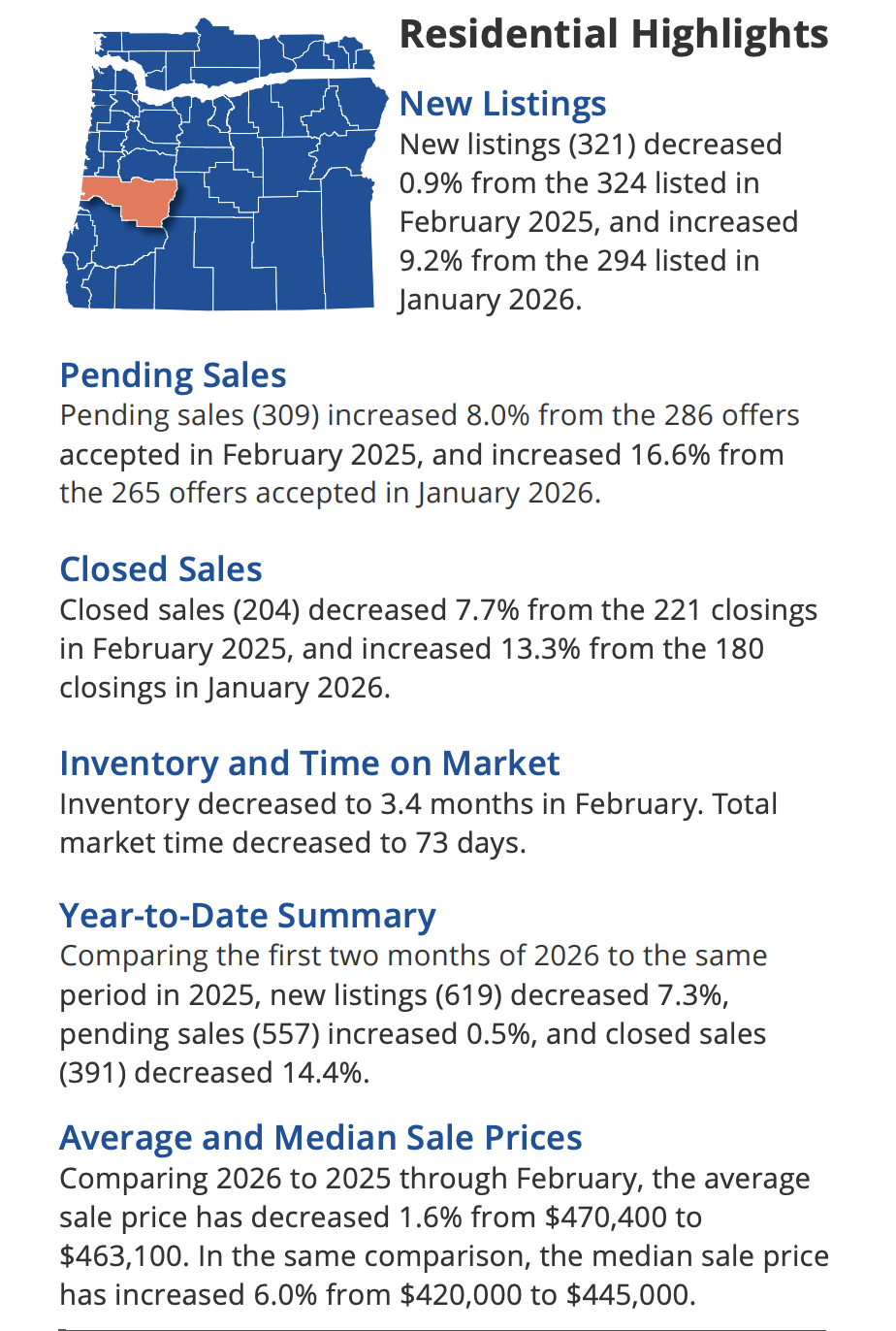
Just maybe, our local real estate market is starting to pick up. After months of stagnation, February saw an increase in pending sales and closed transactions, along with a shorter average time on the market. The inventory of homes shrank a bit, and purchase prices increased. With mortgage interest rates dipping below 6%, the market has certainly come alive. The only negative I see in February is that home prices jumped. If this trend continues, rising prices could negate much of the affordability gained from the lower mortgage interest rates. The following are the home sales statistics for Lane County for February 2026.


Haas Team Real Estate

541.349.2620

galand@galandhaas.com